AT&T has made a significant change to its home internet offerings in 2026. The company simplified its fiber lineup, introduced a faster entry-level option, and expanded opportunities for customers to save by combining home internet and wireless service.
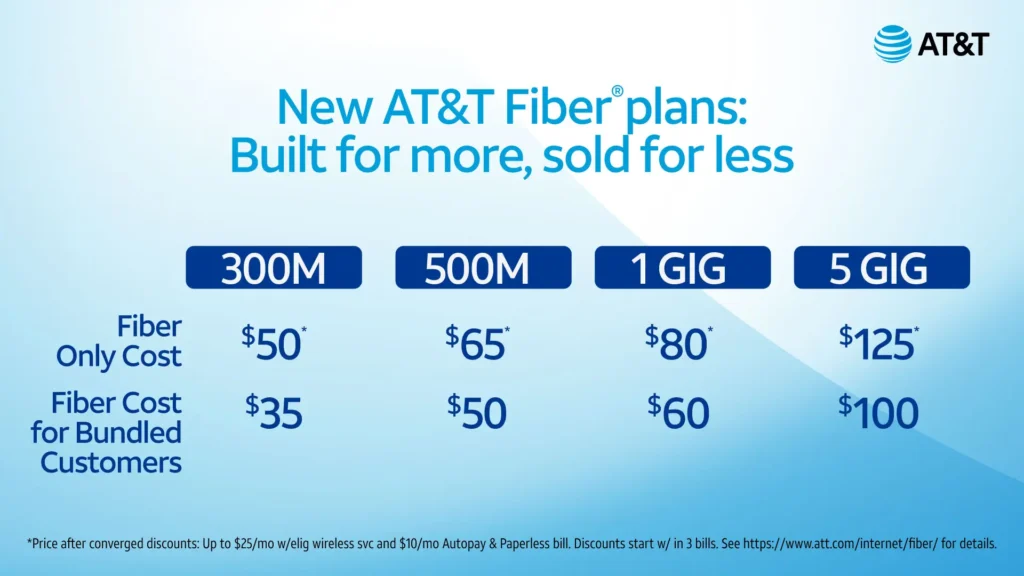
On June 3, 2026, AT&T announced its new fiber internet plans. The changes took effect on June 7, replacing the previous lineup with four standard speed options: 300 Mbps, 500 Mbps, 1 Gig, and 5 Gig.
The announcement matters for both new and existing internet customers. AT&T no longer offers its former 100 Mbps and 2 Gig tiers as part of the new standard residential fiber lineup. Meanwhile, competing providers continue to offer different speed combinations, including 2 Gig and even 7 Gig service.
So, how do the new AT&T Fiber plans for 2026 compare with Verizon Fios, Frontier, Kinetic, Xfinity, and Spectrum? Is AT&T still a competitive choice, or can another provider offer better value?
This guide explores AT&T’s updated fiber plans, current advertised prices, wireless bundle discounts, and the main differences between major U.S. internet providers.
If you are shopping for home internet, you can also compare residential internet providers to explore your options.
Table of Contents
AT&T Fiber Plans: What Changed in June 2026?
AT&T’s announcement introduced a simpler approach to residential fiber internet. Instead of offering numerous speed tiers, the company now focuses on four options for different household needs.
The main changes include a faster entry-level plan, the removal of the standard 2 Gig tier, and discounts for customers who combine qualifying wireless and home internet service.
Four Fiber Plans Replace the Previous Lineup
The new AT&T Fiber lineup starts at 300 Mbps and reaches 5 Gbps in areas where the fastest service is available.
The following table shows AT&T’s advertised standalone prices without a qualifying wireless bundle.
| AT&T Fiber Plan | Download Speed | Monthly Price | Best For |
|---|---|---|---|
| Internet 300 | Up to 300 Mbps | $50 | Everyday internet use and smaller households |
| Internet 500 | Up to 500 Mbps | $60 | Families, streaming, gaming, and remote work |
| Internet 1000 | Up to 1 Gbps | $70 | Busy households and heavy internet use |
| Internet 5000 | Up to 5 Gbps | $110 | Advanced home networks and demanding users |
Prices reflect AT&T’s publicly advertised offers as of November 2026. They include a $10 monthly discount with eligible AutoPay and paperless billing but exclude taxes and fees. Plans, speeds, promotional conditions, and availability vary by address.
With 300 Mbps as its starting point, AT&T now focuses on speeds that can comfortably support modern households with multiple connected devices.
The 500 Mbps and 1 Gig options provide additional capacity for families, remote workers, gamers, and people who regularly transfer large files.
The 5 Gig plan remains AT&T’s premium residential fiber option, although customers need compatible networking equipment to take full advantage of multi-gigabit speeds.
Why Did AT&T Simplify Its Fiber Plans?
AT&T says it wants customers to understand their options more easily.
The new lineup reduces the number of standard speed choices and makes it simpler to select a plan based on household needs.
For example, a customer who mainly streams television, browses websites, and joins video calls may find the 300 Mbps plan sufficient. A larger household with several heavy internet users may prefer 500 Mbps or 1 Gig.
However, fewer choices also mean less flexibility at certain speed levels.
The removal of the 2 Gig tier is particularly interesting because several competing providers continue to offer this intermediate multi-gigabit option.
What Happened to AT&T’s 2 Gig Internet Plan?
Before June 2026, AT&T offered a 2 Gig residential fiber plan positioned between its 1 Gig and 5 Gig services.
The revised standard lineup no longer includes that option.
Customers shopping for new residential AT&T Fiber service must now choose between 1 Gig and 5 Gig if they want one of the higher-speed plans.
That creates a sizable gap.
For some households, 1 Gig provides plenty of bandwidth. Others may want more than 1 Gig but have little reason to pay for 5 Gig service.
AT&T has not established through this announcement that every existing 2 Gig subscriber must change plans. Existing customers should review their account terms before assuming their current service will change.
For new customers who specifically want 2 Gig internet, providers such as Verizon Fios, Frontier, and Kinetic remain worth comparing.
AT&T Fiber and Wireless Bundles: What’s New?
AT&T’s updated fiber lineup also places greater emphasis on combining home internet with wireless service.
Customers who qualify for bundled offers can receive additional savings, making AT&T more attractive to households that already use its mobile network.
AT&T Advertises Savings of Up to $420 Per Year
AT&T’s announcement highlights potential annual savings of up to $420 for customers meeting specific service and payment requirements.
However, the amount combines different discounts.
AT&T’s published example uses a $25 monthly wireless bundle discount on the 5 Gig plan, plus a $10 monthly AutoPay and paperless-billing discount.
Together, those discounts total $35 per month, or $420 over 12 months.
The full amount does not represent a wireless bundle discount alone.
Customers must meet the applicable eligibility requirements, and actual savings depend on the fiber speed tier, wireless plan, and available promotions.
Internet Backup Adds Another Benefit
AT&T also introduced Internet Backup as a benefit for qualifying fiber and wireless customers.
The feature uses eligible AT&T cellular service to help maintain connectivity if the fiber connection experiences a network disruption.
Once customers complete the required setup, the system can switch to the cellular connection during a qualifying outage and return to fiber when service resumes.
A compatible smartphone must remain near the gateway, and other eligibility requirements apply.
This feature may appeal to households that depend on internet access for work, school, communication, and everyday activities.
AT&T All-Fi Pro and Enhanced Home Wi-Fi
AT&T also promotes All-Fi Pro, an enhanced Wi-Fi package designed for households with demanding wireless needs.
Its features include advanced Wi-Fi technology, equipment upgrade options, internet security tools, and expanded home coverage services.
The original announcement associated All-Fi Pro with the premium 5 Gig offering. AT&T’s current shopping page also displays All-Fi Pro as a separately priced option, so customers should confirm the exact inclusion and monthly cost during checkout.
For households with many connected devices, Wi-Fi equipment and coverage can matter just as much as the advertised fiber speed.
A fast connection will not deliver its full benefit if an older router or weak Wi-Fi signal limits performance throughout the home.
How Do AT&T’s New Fiber Plans Compare With Other Internet Providers?
AT&T faces competition from several major broadband providers across the United States.
Verizon Fios, Frontier, and Kinetic offer fiber plans with different speed tiers and pricing structures. Xfinity and Spectrum also compete for residential customers, primarily through cable-based broadband services.
Not all providers serve the same geographic areas, and advertised offers vary by address.
The following comparison provides a general overview of currently featured plans.
Major U.S. Internet Provider Plans at a Glance
| Provider | Advertised Speed Tiers | Advertised Starting Price |
|---|---|---|
| AT&T Fiber | 300 Mbps, 500 Mbps, 1 Gig, 5 Gig | $50/mo |
| Verizon Fios | 300 Mbps, 500 Mbps, 1 Gig, 2 Gig, 5 Gig | $30/mo |
| Frontier Fiber | 500 Mbps, 1 Gig, 2 Gig, 5 Gig, 7 Gig | $44.99/mo |
| Kinetic | 300 Mbps, 1 Gig, 2 Gig, 2 Gig Max | $39.99/mo |
| Xfinity | 300 Mbps, 500 Mbps, 1 Gig | $45/mo |
| Spectrum | 100 Mbps, 500 Mbps, 1 Gig, 2 Gig | $30/mo |
Prices are examples from provider websites (updated in November 2026), not guaranteed nationwide quotes. They may require AutoPay, paperless billing, specific payment methods, qualifying service, or other promotional conditions. Taxes, fees, equipment, and availability vary. Some tiers are available only in select markets.
The table reveals several important differences.
AT&T offers fewer standard tiers than Verizon Fios and Frontier. Frontier advertises the highest residential fiber speed among these providers, while Kinetic continues to offer a 2 Gig option.
Xfinity and Spectrum provide alternatives for households that cannot obtain fiber service.
However, price alone does not reveal the full value of each plan. Upload speeds, equipment, installation costs, service guarantees, and available discounts also matter.
AT&T Fiber vs Verizon Fios
Verizon Fios is one of AT&T’s strongest fiber competitors, particularly in the northeastern United States.
Both providers deliver fiber-optic internet with fast download speeds, strong upload performance, and options for demanding households.
However, Verizon Fios offers more intermediate speed choices.
Verizon Fios Plans and Current Prices
Verizon currently advertises five Fios speed tiers.
| Verizon Fios Plan | Monthly Price |
|---|---|
| Fios 300 Mbps | $30 |
| Fios 500 Mbps | $65 |
| Fios 1 Gig | $80 |
| Fios 2 Gig | $90 |
| Fios 5 Gig | $100 |
These are Verizon’s published price examples, including a $10 Auto Pay discount. Additional conditions, promotions, taxes, and availability may apply.
The most important difference is Verizon’s continuing support for 2 Gig internet.
While AT&T removed that tier from its standard lineup, Verizon offers it between 1 Gig and 5 Gig.
Verizon also promotes multi-year price guarantees, with the applicable term depending on the plan.
AT&T may offer better value at certain speeds or when customers qualify for wireless bundle discounts. Verizon may appeal to shoppers who specifically want 2 Gig service or prefer its current price-guarantee terms.
Both providers offer mobile and home internet savings opportunities, although the details differ.
For a more detailed comparison, read our AT&T Internet vs Verizon Internet guide.
AT&T Fiber vs Frontier Fiber
Frontier Fiber offers a broader selection of high-speed residential plans than AT&T.
Its lineup starts at 500 Mbps and extends to 7 Gig in qualifying areas.
Frontier also continues to offer 2 Gig internet, which fills the gap between AT&T’s current 1 Gig and 5 Gig options.
Frontier Fiber Plans and Current Prices
| Frontier Fiber Plan | Monthly Price |
|---|---|
| Fiber 500 | $44.99 |
| Fiber 1 Gig | $64.99 |
| Fiber 2 Gig | $79.99 |
| Fiber 5 Gig | $104.99 |
| Fiber 7 Gig | $124.99 |
These publicly advertised prices reflect qualifying offers with applicable payment and promotional conditions. Additional discounts, eligibility requirements, and availability restrictions may apply.
Frontier emphasizes symmetrical fiber speeds, advanced Wi-Fi equipment, and higher-speed options for demanding households.
Its 7 Gig plan stands out for users who want more bandwidth than AT&T’s current maximum of 5 Gig.
However, the real-world benefits of 7 Gig service depend heavily on the customer’s equipment and usage.
Frontier Is Now Part of Verizon
Another important development occurred earlier in 2026.
Verizon completed its acquisition of Frontier on January 20, 2026.
Frontier is now a Verizon company, although customers may continue seeing the Frontier brand, separate offers, and existing service arrangements during the integration process.
This means Frontier and Verizon are no longer independent corporate competitors.
Consumers should still compare the available Frontier and Fios plans because pricing, technology, and availability can differ by service area.
You can explore additional information on our Frontier Internet page.
AT&T Fiber vs Kinetic Fiber
Kinetic offers another interesting comparison with AT&T, especially for households looking for affordable gigabit internet or a 2 Gig option.
Kinetic’s currently featured residential lineup includes 300 Mbps, 1 Gig, 2 Gig, and an enhanced 2 Gig Max package.
Kinetic Internet Plans and Prices
| Kinetic Plan | Monthly Price |
|---|---|
| 300 Mbps | $39.99 |
| 1 Gig | $49.99 |
| 2 Gig | $69.99 |
| 2 Gig Max | $89.99 |
Prices reflect Kinetic’s advertised offers and may depend on location, eligibility, and promotional conditions.
The main difference is Kinetic’s continued availability of a 2 Gig plan.
Kinetic also promotes 2 Gig Max, which combines multi-gigabit speeds with additional Wi-Fi and support features.
The enhanced package includes advanced eero equipment, security services, expanded Wi-Fi coverage features, and premium technical support.
Kinetic also advertises internet discounts for eligible AT&T Wireless customers. That makes its offerings worth checking for households already using AT&T mobile service.
Unlike AT&T’s standard fiber lineup, Kinetic’s featured options do not currently include a 5 Gig residential tier.
For homes that need 1 Gig or 2 Gig speeds, however, Kinetic may provide competitive alternatives where service is available.
Explore our Kinetic Fiber Internet plans for more information.
How Do Xfinity and Spectrum Compare?
Not every household can obtain fiber-to-the-home service.
Xfinity and Spectrum remain important alternatives because they serve many areas through broadband networks that primarily use fiber infrastructure connected to homes by coaxial cable.
These services can provide fast download speeds, but upload performance and network characteristics may differ from dedicated fiber-to-the-home connections.
Xfinity Internet Plans
Xfinity currently advertises the following residential internet options:
| Xfinity Plan | Advertised Monthly Price |
|---|---|
| 300 Mbps | $45 |
| 500 Mbps | $50 |
| 1 Gig | $60 |
These examples reflect qualifying offers with a five-year price guarantee. Promotional requirements, taxes, fees, and availability apply.
Xfinity highlights included Wi-Fi equipment, unlimited data, and no annual contract on eligible current offers.
The provider also promotes a separate one-year 300 Mbps offer at a lower introductory price in qualifying situations.
Its current five-year pricing approach may appeal to households that prioritize predictable monthly costs.
However, consumers should compare upload speeds and connection technology before choosing Xfinity over a fiber provider.
Our AT&T Internet vs Xfinity Internet comparison explores additional differences between the providers.
Spectrum Internet Plans
Spectrum offers several residential speed tiers, including a 2 Gig option in select areas.
| Spectrum Plan | Advertised Monthly Price |
|---|---|
| Internet 100 | $30 |
| Internet 500 | $40 |
| Internet 1 Gig | $60 |
| Internet 2 Gig | $80 |
These are advertised first-year internet-only price examples. Available promotions, equipment, bundle discounts, and pricing after the promotional period may differ.
Spectrum also promotes packages combining internet and mobile service.
Its availability of 2 Gig internet gives certain households another multi-gigabit option, although that does not make the service technically identical to a symmetrical fiber connection.
When comparing Spectrum with AT&T Fiber, examine both download and upload speeds, promotional pricing, and the total cost after any introductory period.
Fiber vs Cable: Why Connection Type Matters
Fiber-to-the-home internet generally delivers stronger upload performance than traditional cable broadband.
This can matter when customers upload large files, use cloud backups, join video meetings, or work with online applications.
Cable internet can still offer excellent performance for streaming, browsing, gaming, and everyday household needs.
The best choice depends on available speeds, actual prices, local performance, and the household’s usage patterns.
Is AT&T’s New 300 Mbps Entry-Level Plan Enough?
One of the biggest changes in AT&T’s 2026 lineup is the move to 300 Mbps as its standard entry-level fiber speed.
But does every household need 300 Mbps?
For many homes, it is more than enough.
A 300 Mbps fiber connection can support common activities such as streaming television, video conferencing, online gaming, browsing, schoolwork, and smart home devices.
The amount of bandwidth a household needs depends on how many people use the connection and what they do online at the same time.
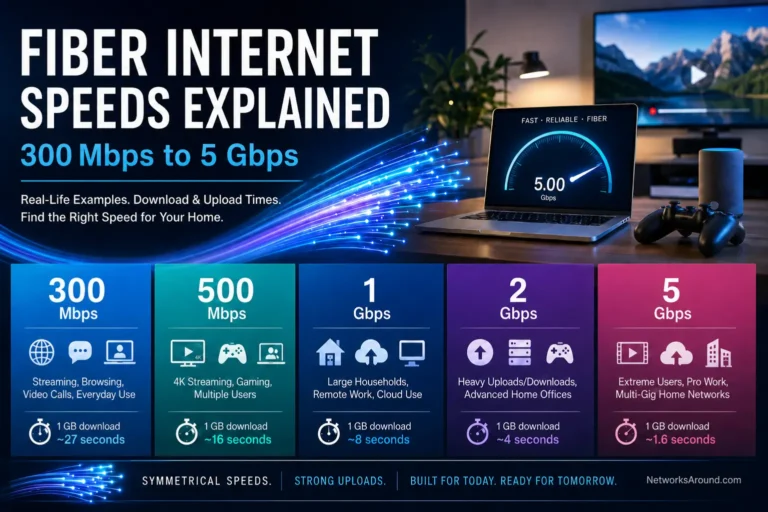
Which Internet Speed Should You Choose?
| Internet Speed | Typical Household Needs |
|---|---|
| 300 Mbps | Everyday browsing, streaming, gaming, video calls, and smaller households |
| 500 Mbps | Families with multiple active users and connected devices |
| 1 Gig | Larger households, frequent downloads, heavy cloud use, and advanced home offices |
| 2 Gig | Demanding multi-user homes and frequent large file transfers |
| 5 Gig or higher | Specialized workloads, advanced home networks, and extreme bandwidth demands |
These recommendations are general guidelines rather than strict requirements.
For example, a household with several connected devices may still perform well on 300 Mbps if those devices use relatively little bandwidth.
A single remote worker who regularly transfers enormous video files may benefit more from gigabit fiber than a larger family that mostly streams and browses.
The key is to match the internet plan to actual usage, rather than simply choosing the largest speed number.
For a deeper explanation, read our guide to what fiber internet speeds mean.
Why Some Competitors Still Offer 2 Gig Internet
AT&T’s removal of the 2 Gig tier creates an interesting difference between its lineup and competing providers.
Verizon Fios, Frontier, and Kinetic continue to advertise 2 Gig residential service.
The appeal is straightforward: 2 Gig offers more bandwidth than 1 Gig without requiring customers to move directly to a 5 Gig plan.
This may work well for households with several heavy users, advanced home offices, professional content creators, or frequent large uploads and downloads.
However, a 2 Gig connection will not automatically make every website, streaming service, or online game run twice as fast as it would on 1 Gig.
Multi-Gig Internet Requires Compatible Equipment
Customers should also consider their home networking equipment.
A 2 Gig plan may require a router with multi-gigabit Ethernet ports, compatible network adapters, and suitable cabling to reach its full speed on a wired device.
Many computers and routers still use 1 Gig Ethernet connections. Those connections can limit individual wired devices regardless of the internet plan’s higher speed.
Wi-Fi speeds also depend on the router, device, distance, interference, and network conditions.
A 5 Gig plan may provide substantial shared bandwidth, but only compatible devices can approach those speeds individually.
For households without specialized needs, 300 Mbps, 500 Mbps, or 1 Gig may deliver better overall value.
What Should Consumers Compare Besides Internet Speed?
The monthly price and advertised download speed are important, but they do not tell the whole story.
Before choosing an internet provider, consider several additional factors.
Upload Speeds and Symmetrical Connections
Upload speeds affect video calls, cloud backups, file sharing, remote work, and content creation.
Fiber connections often provide upload speeds similar to download speeds. Traditional cable plans may offer much lower uploads, although performance varies by network and location.
Equipment and Wi-Fi Costs
Check whether the monthly price includes a router, gateway, or advanced Wi-Fi service.
Some providers include standard equipment but charge extra for premium networking features, extended coverage, or technical support.
Installation Charges
Installation may be free under a promotion or included with selected plans.
Other providers may charge for professional installation, activation, or certain service arrangements.
Contracts and Price Guarantees
Some providers advertise multi-year price guarantees, while others use introductory promotional rates.
A price guarantee may cover the base internet rate without preventing changes to taxes, fees, optional services, or other excluded charges.
Always read the conditions.
Data Limits and Network Management
Check whether a plan includes unlimited data or places restrictions on usage.
Even when providers advertise unlimited data, customers should review the applicable service terms and any network management policies.
Mobile and Internet Bundles
Combining internet and mobile service can reduce monthly costs.
However, bundled savings only provide real value if both services meet your needs at competitive prices.
A lower internet bill may not justify switching to a more expensive wireless plan.
Availability at Your Address
Finally, check the exact service address.
A provider may advertise fiber service in your city without offering it on your street or in your building.
Likewise, its fastest plans may only be available in certain neighborhoods.
Which Fiber Internet Provider Offers the Best Value?
No single internet provider offers the best value for every household.
AT&T’s simplified lineup may work well for customers who want clear speed choices and can benefit from qualifying wireless discounts.
Verizon Fios and Frontier provide more flexibility for customers interested in 2 Gig service, while Frontier also offers plans reaching 7 Gig.
Kinetic remains worth considering for customers seeking 1 Gig or 2 Gig speeds at competitive advertised prices.
Xfinity and Spectrum offer alternatives where dedicated fiber-to-the-home connections are unavailable or where their promotions provide better value.
The following table summarizes where to start.
| Your Priority | Providers Worth Comparing |
|---|---|
| Simple fiber plan selection | AT&T Fiber |
| A 2 Gig fiber plan | Verizon Fios, Frontier, Kinetic |
| Fiber speeds above 5 Gig | Frontier |
| Affordable gigabit internet | AT&T, Frontier, Kinetic, Verizon Fios |
| Mobile and internet bundles | AT&T, Verizon, Frontier, Kinetic |
| Cable broadband alternatives | Xfinity, Spectrum |
| Long-term promotional price guarantees | Verizon Fios, Frontier, Xfinity |
These are comparison starting points, not universal provider rankings.
For example, a Verizon promotion may offer an attractive price in one area, while AT&T or Kinetic may provide better value somewhere else.
The total cost and available features at your address should determine the final choice.
How to Find the Best Internet Plan Available at Your Address
The most practical way to compare internet providers is to begin with availability.
Even when several companies advertise service in the same city, their exact coverage and speed options can differ from one neighborhood to another.
Start by identifying which providers serve your address.
Then compare their available plans using the same criteria: download speed, upload speed, monthly price, equipment, installation, contract terms, and promotional conditions.
Before signing up, ask these questions:
- Which providers offer service at my exact address?
- Is fiber-to-the-home available, or does the connection use cable or fixed wireless?
- How much download and upload speed does my household need?
- What is the monthly cost after all required discounts?
- Does the price include equipment and Wi-Fi?
- Will the price change after a promotional period?
- Can I save money by combining wireless and home internet?
- Will my existing router and devices support the advertised speed?
- What happens if I cancel or change service?
You do not always need the fastest available plan. A well-priced 300 Mbps or 500 Mbps fiber connection can offer excellent everyday performance.
If you need dependable internet for work, streaming, gaming, or a busy household, focus on the combination of speed, price, and reliability.
Visit our Fiber Internet Service Providers page to explore residential internet options and check availability.
AT&T’s New Fiber Plans: Simpler Choices, but More Competition
AT&T’s 2026 fiber update makes its residential lineup easier to understand.
Customers now choose among four standard speeds: 300 Mbps, 500 Mbps, 1 Gig, and 5 Gig.
The faster entry-level plan provides plenty of bandwidth for many households, while the premium 5 Gig option serves users with more demanding needs.
AT&T also strengthens its appeal through wireless bundle discounts and additional connectivity features.
However, the simplified lineup does not automatically make AT&T the best provider for every customer.
Verizon Fios, Frontier, and Kinetic continue to offer 2 Gig options. Frontier also advertises 7 Gig service, while Xfinity and Spectrum compete through pricing, bundles, and broad broadband availability.
For most households, the best value comes from choosing enough speed without paying for unnecessary capacity.
If AT&T Fiber is available at your address, it deserves consideration. But before signing up, compare the total cost, available speeds, and features from other providers serving your home.
A little research can help you choose an internet plan that delivers the performance you need at a price that makes sense.
Frequently Asked Questions About AT&T Fiber Plans
What are the new AT&T Fiber plans for 2026?
AT&T’s revised standard residential fiber lineup includes 300 Mbps, 500 Mbps, 1 Gig, and 5 Gig plans. The changes took effect on June 7, 2026. Prices and availability depend on the address and applicable discounts.
Did AT&T discontinue its 2 Gig fiber plan?
AT&T removed 2 Gig from its new standard residential fiber lineup in June 2026. New customers generally choose between 1 Gig and 5 Gig for higher-speed service. Existing subscribers should check their account terms to determine whether their current plan remains available.
What is the cheapest AT&T Fiber plan?
AT&T currently advertises Internet 300 at $50 per month without a wireless bundle, after an eligible AutoPay and paperless-billing discount. Additional discounts may apply to qualifying customers. Taxes, fees, and availability restrictions apply.
Can I save money by combining AT&T Fiber and wireless?
Yes. AT&T offers discounts for qualifying customers who combine fiber and wireless service. Its June 2026 announcement highlighted potential annual savings of up to $420 under specific conditions, including eligible wireless and AutoPay discounts on the 5 Gig plan.
Does Verizon Fios still offer 2 Gig internet?
Yes. Verizon Fios continues to advertise a 2 Gig fiber plan, along with 300 Mbps, 500 Mbps, 1 Gig, and 5 Gig options. Availability depends on the customer’s address.
Which provider offers faster residential fiber plans than AT&T?
Frontier advertises a 7 Gig residential fiber plan in qualifying areas, exceeding AT&T’s current standard maximum of 5 Gig. However, most households do not need that much bandwidth, and compatible networking equipment is necessary to use the additional capacity.
Is 300 Mbps enough for most households?
Yes, 300 Mbps can handle everyday streaming, browsing, gaming, video calls, and multiple connected devices for many households. Larger families or people who regularly transfer large files may benefit from 500 Mbps or 1 Gig service.
Is AT&T Fiber better than cable internet?
AT&T Fiber often offers stronger upload speeds and more consistent performance than traditional cable connections. However, cable providers such as Xfinity and Spectrum may offer competitive prices and sufficient speeds for many homes. The best choice depends on local availability, cost, and household needs.
Are Verizon Fios and Frontier the same company?
Verizon completed its acquisition of Frontier in January 2026. Frontier now belongs to Verizon, although the two service brands may continue offering different plans, prices, and service arrangements during integration.
Should I choose 1 Gig or 5 Gig AT&T Fiber?
Most households will find 1 Gig more than sufficient for streaming, gaming, video calls, and remote work. The 5 Gig option makes more sense for advanced home networks, professional file transfers, and households with unusually high bandwidth demands.