Fiber internet and 5G home internet can both give households fast online access, but they work in very different ways. Fiber internet uses a wired fiber-optic connection, while 5G home internet uses a wireless cellular signal and a home gateway.
The better choice depends on what you need from your connection. Some households care most about speed, gaming, video calls, and reliability. Others care more about simple setup, flexible availability, and avoiding complicated installation.
If you are comparing home internet options, start by checking which providers and connection types serve your address. You can compare residential internet providers to see which home internet services may be available in your area.
Table of Contents
Fiber Internet vs 5G Home Internet: What’s the Difference?
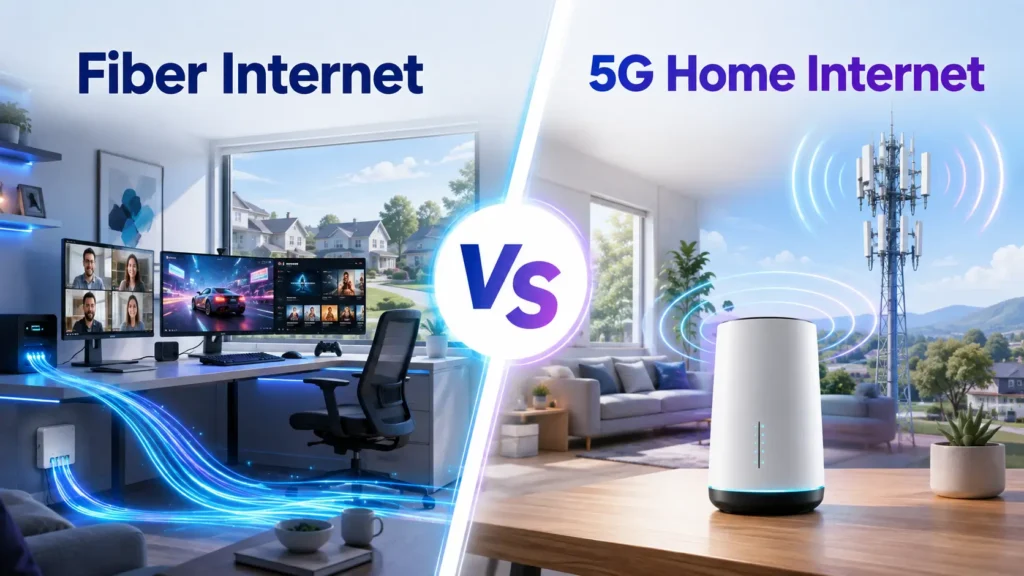
The main difference between fiber internet and 5G home internet is how the service reaches your home.
Fiber internet uses fiber-optic cables to deliver internet service to a home or building. It usually offers strong speed, stable performance, and better upload potential than many other internet types.
5G home internet uses a wireless cellular network instead of a wired line. A 5G gateway receives the signal and creates a Wi-Fi network inside the home.
Both options can work well, but they fit different needs. Fiber usually wins on consistency and performance. 5G home internet often wins on simple setup and convenience, especially in areas where wired options are limited.
What Is Fiber Internet?
Fiber internet uses fiber-optic cables that send data through light signals. This type of connection can deliver fast download speeds, strong upload speeds, and stable performance for many household activities.
Fiber internet works well for:
- Streaming movies and TV shows
- Online gaming
- Video meetings
- Remote work
- Cloud backups
- Large file uploads
- Smart home devices
- Large households with many connected devices
Many fiber plans also offer symmetrical speeds, which means the download and upload speeds are similar. This can help users who send large files, use video calls often, back up data to the cloud, or work from home.
The main limitation is availability. Fiber service must reach your home or neighborhood before you can order it. Some homes may also need professional installation or specific fiber equipment. If you want to explore wired home internet options, you can review fiber internet options for your home.
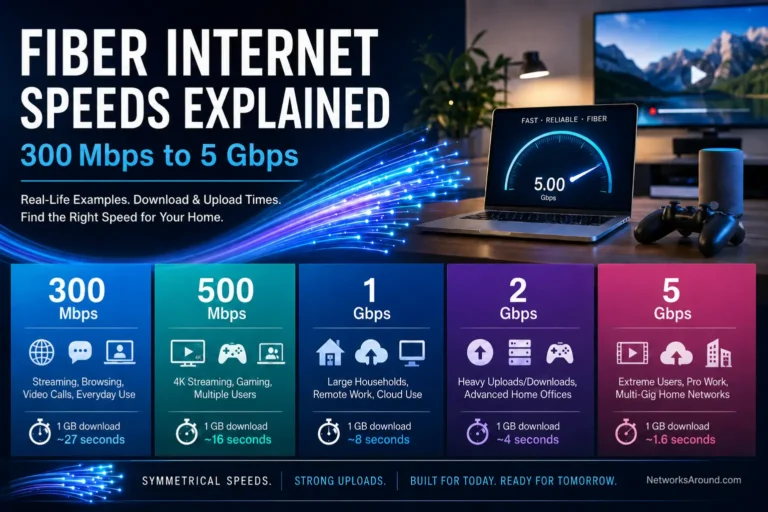
Want a deeper explanation of how fiber works and why it can deliver such strong performance?
Read our guide on what fiber internet is to learn more about fiber-optic technology, speeds, and home internet benefits.
What Is 5G Home Internet?
5G home internet uses a provider’s cellular network to deliver home internet service. Instead of connecting through fiber, cable, or DSL wiring, your home connects through a 5G gateway. The gateway receives the wireless signal and provides Wi-Fi for your devices.
5G home internet can appeal to people who want a simple setup. In many cases, customers can install the gateway themselves by plugging it in, placing it in a good location, and connecting devices to Wi-Fi.
5G home internet may work well for:
- Browsing
- Streaming
- Basic remote work
- Smaller households
- Homes with limited wired internet options
- Users who want easier setup
However, performance can depend on signal strength, network traffic, gateway placement, nearby tower capacity, and building materials. A strong 5G signal can deliver good performance, while a weak or congested signal may create slower speeds or less consistent service.
To better understand the wireless side of the comparison, read our guide on what fixed wireless 5G internet is.
It explains how 5G home internet works, how it connects your home, and when it may be a good alternative to wired service.
Fiber vs 5G Home Internet: Main Differences
Fiber and 5G home internet can both support everyday online use, but they differ in connection type, installation, consistency, upload speed, latency, and long-term performance.
| Feature | Fiber Internet | 5G Home Internet |
|---|---|---|
| Connection Type | Wired fiber-optic connection | Wireless cellular connection |
| Installation | May need professional installation | Often supports self-installation |
| Speed Consistency | Usually more consistent | Can vary by signal and network traffic |
| Upload Speeds | Often stronger, especially with symmetrical fiber | Usually lower than download speeds |
| Latency | Usually lower and more stable | Can vary by signal quality and congestion |
| Reliability | Strong for heavy home use | Depends on coverage, signal, and tower capacity |
| Best For | Streaming, gaming, remote work, and large households | Easy setup, flexible service, and areas with limited wired options |
| Availability | Depends on fiber buildout | Depends on 5G coverage and provider capacity |
| Main Advantage | Performance and stability | Convenience and simple setup |
Fiber usually offers the stronger long-term connection for households that need consistent performance. 5G home internet can still be a smart choice when fiber is unavailable, installation needs to be simple, or the household does not need the most demanding performance.
If you are ready to compare provider options, AT&T and Verizon are two major names to review. AT&T offers fiber internet where available, along with other home internet options, while Verizon offers both fiber-based home internet and 5G Home Internet in select areas.
You can learn more about AT&T Internet plans and Verizon Home Internet plans to see which provider may better fit your address, speed needs, and budget.
Speed and Performance
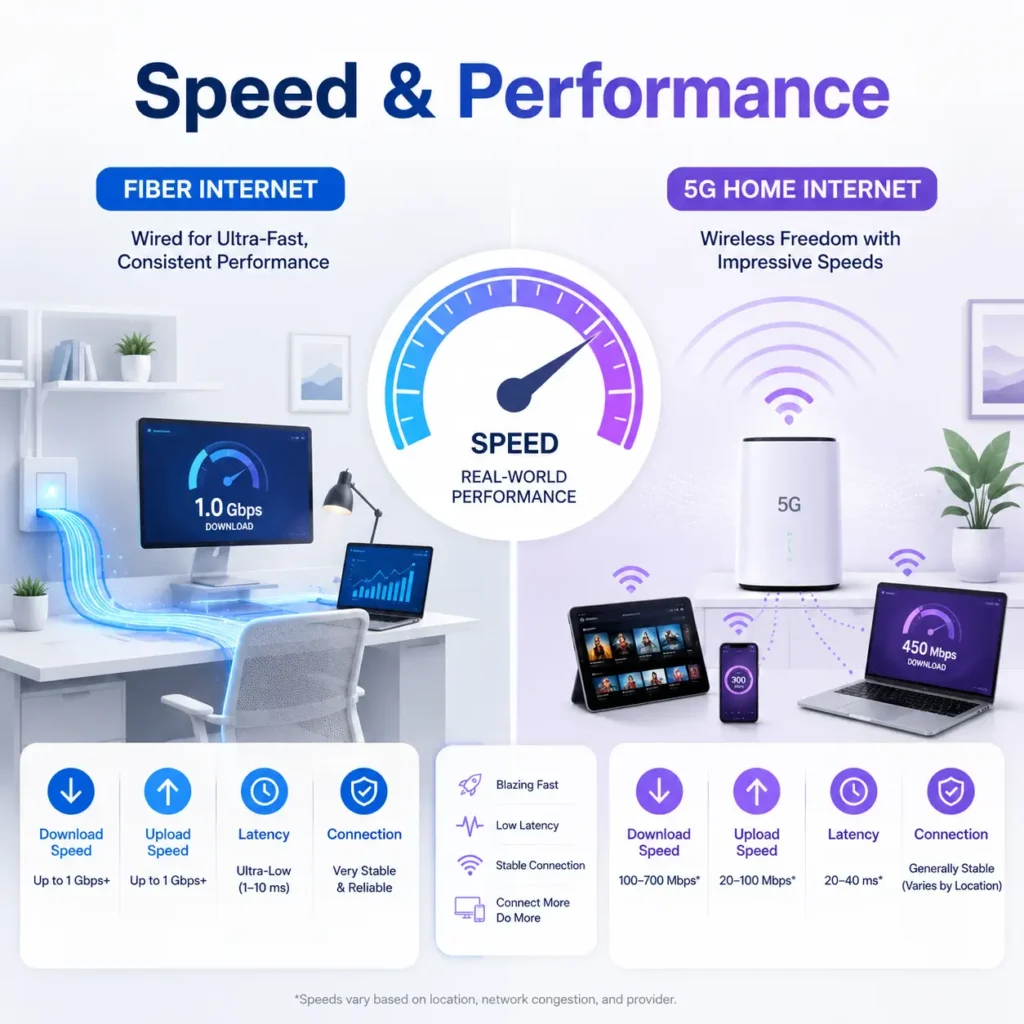
Speed matters, but real-world performance depends on more than the number advertised on a plan page. Download speed, upload speed, latency, device count, Wi-Fi quality, and network congestion all affect how the internet feels in daily use.
Fiber internet often delivers more consistent speeds because it uses a wired connection. Once the fiber line reaches the home, performance usually depends less on wireless signal strength outside the house.
5G home internet can also deliver fast speeds, but those speeds may change throughout the day. Signal strength, distance from the nearest tower, tower congestion, weather conditions, and the location of the gateway inside the home can all affect performance.
For everyday browsing and streaming, both options may work well. For larger households, serious gaming, frequent video meetings, heavy uploads, and remote work, fiber usually has the advantage because it tends to provide more stable performance.
If you want a clearer explanation of download speed, upload speed, latency, and how speed numbers affect daily use, read our guide on what internet speeds mean.
Upload Speeds: Why Fiber Often Has the Advantage
Many people focus on download speed first. Download speed affects streaming, browsing, app updates, large downloads, and how quickly websites load. However, upload speed has become more important as more people work, learn, and create from home.
Upload speed affects:
- Video calls
- Cloud backups
- File sharing
- Online classes
- Remote work tools
- Content uploads
- Security camera uploads
- Sending large photos, videos, or work files
Fiber internet often offers stronger upload performance than 5G home internet. Some fiber plans provide symmetrical speeds, which means users get similar download and upload performance.
That can make a noticeable difference for remote workers, content creators, students, small business owners, and anyone who sends large files regularly. A 5G home internet plan may work well for normal use, but fiber usually gives upload-heavy households more room to work.
Reliability and Consistency
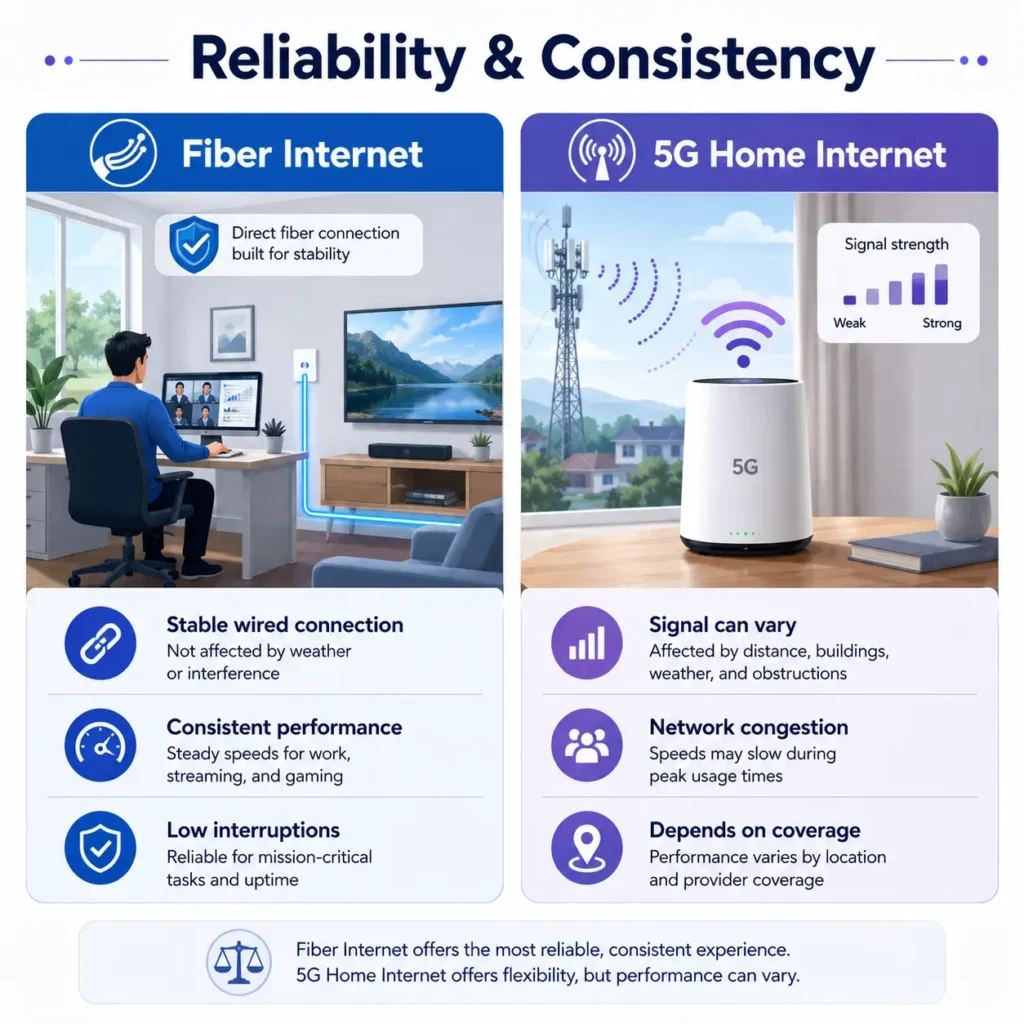
Reliability is one of the biggest differences between fiber internet and 5G home internet. A fast plan does not help much if the connection slows down or drops at the wrong time.
Fiber internet usually provides a more consistent connection because it runs through a wired line. This makes it a strong option for homes that depend on stable service throughout the day.
Fiber may work better for:
- Large households
- Heavy streaming
- Online gaming
- Full-time remote work
- Frequent video meetings
- Smart home systems
- Cloud-based work tools
- Users who want more predictable performance
5G home internet depends more on wireless conditions. If the signal is strong and the network has enough capacity, it can perform well. If the signal weakens or the network becomes congested, speeds and latency may change.
5G home internet performance may depend on:
- Signal strength
- Gateway placement
- Building materials
- Distance from the nearest tower
- Network congestion
- Provider coverage in your area
This does not mean 5G home internet is unreliable. It means the quality of the connection can vary more from home to home. One household may get excellent 5G home internet performance, while another home nearby may see weaker results because of signal conditions or network capacity.
Gaming, Latency, and Video Calls
Gaming and video calls depend on more than speed. Latency, jitter, and stability can affect the experience just as much as download speed.
Latency measures how quickly data travels between your device and the internet. Lower latency can improve online gaming, video conferencing, VoIP calls, cloud gaming, and remote desktop tools.
Fiber internet usually performs better for latency because it uses a stable wired connection. Serious gamers, frequent video callers, and remote workers may notice smoother performance with fiber, especially during busy hours.
5G home internet can still work for gaming and video calls if the signal stays strong and stable. However, latency may vary more than it does with fiber. This can matter for competitive gaming, live video calls, VoIP phones, and real-time collaboration tools.
If you play games casually, stream video, and join occasional calls, 5G home internet may work well. If you game competitively, work on video calls all day, or use remote desktop tools, fiber is usually the safer choice when available.
Streaming and Smart Home Devices
Both fiber and 5G home internet can support streaming. The right choice depends on how many people and devices use the connection at the same time.
A smaller household may use 5G home internet successfully for streaming, browsing, smart TVs, phones, tablets, and basic work tasks. If the signal is strong, 5G home internet can deliver a simple and convenient home connection.
A larger household may benefit more from fiber. Multiple TVs, gaming consoles, laptops, smart speakers, security cameras, phones, and tablets can all compete for bandwidth. Fiber usually handles this type of activity more consistently, especially when several people stream, game, and work at the same time.
Smart home devices also matter. A few smart speakers or thermostats will not usually create a problem. However, smart cameras, video doorbells, and cloud-connected devices may use upload bandwidth. Fiber can provide more room for those devices, especially in homes with several cameras or frequent cloud uploads.
Installation and Equipment
Installation can strongly influence the decision between fiber and 5G home internet. Some households want the most stable long-term connection. Others want the fastest and simplest setup.
Fiber Internet Installation
Fiber installation depends on the provider and whether fiber already reaches your home. If your home has not had fiber service before, the provider may need to run a fiber line, install an optical network terminal, or send a technician.
Fiber installation may involve:
- A technician appointment
- Fiber line access at the address
- An optical network terminal or fiber gateway
- A router or Wi-Fi gateway
- A more permanent wired setup
The setup may take more effort at the beginning, but fiber often delivers stronger long-term performance after installation.
5G Home Internet Installation
5G home internet often offers a simpler setup. Many providers use a home gateway that customers can install themselves. The gateway connects to the cellular network and creates a Wi-Fi network in the home.
5G home internet setup may involve:
- Plugging in the gateway
- Activating the service
- Finding the best location for signal
- Connecting devices to Wi-Fi
- Moving the gateway if performance needs improvement
Placement matters. A 5G gateway may work better near a window, on an upper floor, or in an area with stronger signal. This makes setup simple, but it may require some testing to find the best location.
In simple terms, 5G home internet often wins for convenience. Fiber often wins for long-term performance.
Availability: Which One Can You Actually Get?
The best internet type often depends on what providers offer at your address. Fiber may be the stronger connection, but not every home can get it. 5G home internet may be easier to install, but it still depends on wireless coverage and network capacity.
Fiber availability depends on whether the provider has built fiber infrastructure in your neighborhood. Even if fiber exists nearby, it may not reach every home on the same street.
5G home internet availability depends on coverage, signal strength, and whether the provider has enough capacity in your area. A provider may offer mobile 5G service nearby but still limit 5G home internet signups if the local network cannot support more home internet users.
Before deciding, check availability for both options. You may find that fiber, 5G home internet, cable, or another service type gives you the best value at your address. To start comparing options, you can check internet availability in your area.
Pricing and Value
Pricing can vary by provider, location, speed tier, promotion, equipment, taxes, fees, and contract terms. That means the cheaper option on paper may not always deliver the best value.
When comparing fiber and 5G home internet, look at:
- Monthly price
- Promotional pricing
- Equipment fees
- Installation costs
- Contracts or no-contract terms
- Download and upload speeds
- Data limits or usage policies
- Long-term price after promotions end
5G home internet may offer simple pricing and easy setup, which can make it attractive for many households. Fiber may offer better value for users who need faster uploads, lower latency, and more consistent performance.
The best value depends on how you use the connection. A smaller household may save money with 5G home internet if the signal is strong. A larger household or remote worker may get better long-term value from fiber because the connection can handle more demanding use.
Who Should Choose Fiber Internet?
Fiber internet is usually the better choice when performance, stability, and upload speed matter most. It can support everyday home use, but it also gives heavy users more room to stream, work, game, upload, and connect many devices.
Fiber internet may be the better choice if you:
- Can get fiber at your address
- Work from home often
- Play online games
- Join frequent video meetings
- Upload large files
- Back up data to the cloud
- Have a large household
- Stream on multiple devices
- Use smart home cameras or security devices
- Want strong upload speeds
- Need a stable long-term connection
If fiber is available where you live, it should usually be near the top of your comparison list. You can compare fiber internet providers and review which home internet options may serve your area.
Who Should Choose 5G Home Internet?
5G home internet can be a strong choice when convenience, simple setup, and availability matter most. It can also help households that do not have access to fiber or want an alternative to cable or DSL.
5G home internet may be the better choice if you:
- Want simple setup
- Cannot get fiber internet
- Want to avoid professional installation
- Have strong 5G coverage at home
- Use the internet for browsing and streaming
- Work from home lightly
- Live in a smaller household
- Want a flexible alternative to cable or DSL
- Do not upload large files often
- Do not need the lowest possible latency
5G home internet can work especially well for users who want a straightforward home connection without a technician visit. However, it works best when the signal is strong and the provider has enough network capacity in the area.
Fiber Internet vs 5G Home Internet for Remote Work
Remote workers should look beyond download speed. A good remote work connection needs reliable upload speed, stable latency, strong Wi-Fi, and enough bandwidth for the whole household.
Fiber internet is usually better for full-time remote work because it can provide stronger stability and better upload performance. This matters for video meetings, cloud file sharing, VPN access, remote desktop tools, client calls, and large file uploads.
Fiber may be the better choice for remote workers who:
- Join video meetings every day
- Use VPN access
- Upload large work files
- Use cloud software throughout the day
- Need stable remote desktop access
- Take client calls from home
- Share the connection with a busy household
5G home internet can still work well for lighter remote work. If you mainly use email, web apps, messaging tools, occasional video calls, and basic cloud documents, a strong 5G home internet connection may be enough.
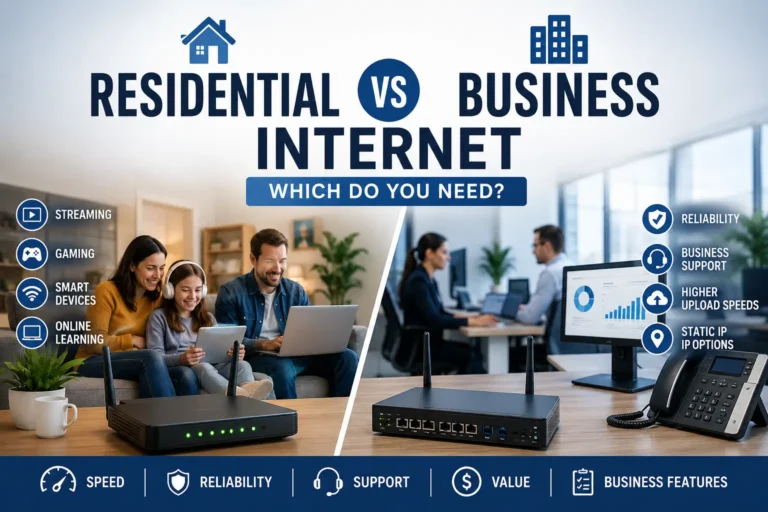
If you run a business from home or depend on your connection for daily income, you may also want to compare the difference between home and business-grade service. Our guide to residential vs business internet explains when a standard home plan is enough and when business internet may make more sense.
How to Choose Between Fiber and 5G Home Internet
The best choice depends on your address, usage, budget, and performance needs. Instead of choosing only by advertised speed, think about how your household actually uses the internet.
Before choosing, ask these questions:
- Is fiber available at your address?
- Is 5G home internet available with strong signal?
- How many people use the connection?
- How many devices connect at the same time?
- Do you work from home?
- Do you need fast upload speeds?
- Do you play online games?
- Do you stream on multiple devices?
- Do you want simple self-installation?
- Is price or performance more important?
- Would inconsistent speeds create problems?
Choose fiber internet if performance, upload speed, latency, and consistency matter most. Fiber usually works better for large households, serious gamers, full-time remote workers, and users who upload large files.
Choose 5G home internet if convenience, quick setup, and availability matter more. 5G home internet can be a good fit for smaller households, basic streaming, browsing, and users who cannot get fiber.
The right plan is not always the fastest or the cheapest. The right plan is the one that matches your home, your devices, and the way you use the internet every day.
The Better Choice Depends on Your Home
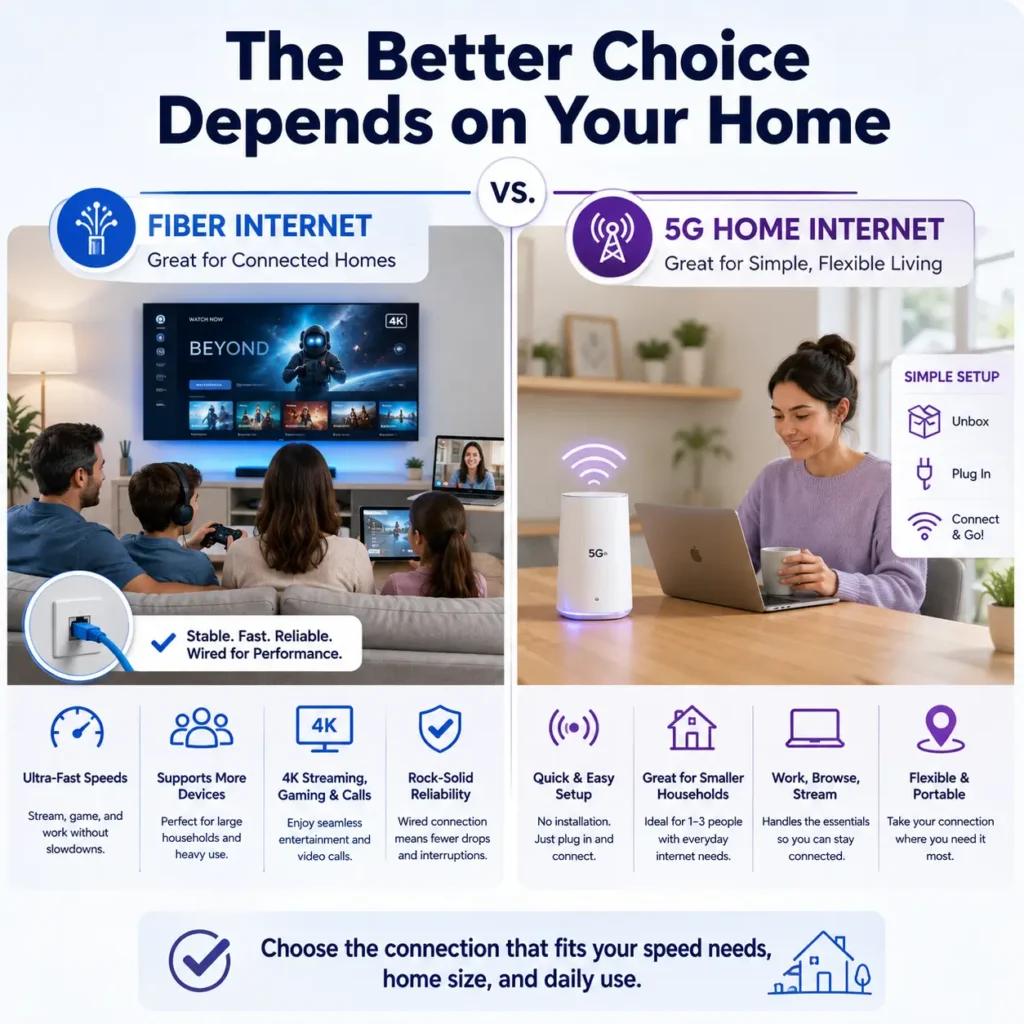
Fiber internet is usually the stronger choice for performance, consistency, upload speeds, gaming, remote work, and heavy household use. If fiber is available at your address and the price fits your budget, it often provides the best long-term home internet experience.
5G home internet can still be a smart alternative. It may work well if you want simple setup, have strong 5G coverage, live in a smaller household, or cannot get fiber where you live.
If both options are available, compare speed, price, upload performance, equipment, installation, and reliability before choosing. If only one option is available, focus on finding the best plan from the strongest provider in your area.
For many households, fiber wins on performance. 5G home internet wins on convenience. The best choice depends on which of those matters more in your home.
Frequently Asked Questions About Fiber Internet vs 5G Home Internet
Is fiber internet better than 5G home internet?
Fiber internet is often better for consistency, upload speed, latency, gaming, remote work, and heavy household use. 5G home internet can still be a good option when fiber is unavailable or when easy setup matters more.
Is 5G home internet fast enough for streaming?
Yes, 5G home internet can be fast enough for streaming, including HD and sometimes 4K streaming. Performance depends on signal strength, provider coverage, plan terms, and how many devices use the connection at the same time.
Is fiber better for gaming?
Fiber is usually better for gaming because it often provides lower latency and more stable performance. 5G home internet may still work for gaming if the signal is strong and latency stays low.
Can 5G home internet replace cable or fiber?
5G home internet can replace wired internet for some households, especially smaller homes or users with strong 5G coverage. Heavy users, gamers, remote workers, and large households may still prefer fiber when it is available.
Which is better for working from home?
Fiber is usually better for full-time remote work, frequent video calls, large file uploads, VPN access, and cloud tools. 5G home internet may work well for lighter remote work if the connection stays stable.
Is 5G home internet good for large households?
5G home internet can work for some large households, but fiber usually provides more consistent performance when many people stream, game, work, and connect devices at the same time.
Does fiber internet need professional installation?
Sometimes. Fiber installation depends on the provider and whether fiber service already reaches the home. Some installations need a technician, while others may use existing equipment or a simpler setup.
Which is cheaper, fiber or 5G home internet?
Pricing depends on provider, location, speed tier, equipment, promotions, and service terms. 5G home internet may offer simple pricing and easy setup, while fiber may offer better long-term value for users who need stronger speed, uploads, latency, and reliability.
Does 5G home internet need a cable line?
No. 5G home internet uses a wireless cellular signal and a home gateway. It does not need a fiber, cable, or DSL line running into the home.
Should I choose fiber or 5G home internet if both are available?
Choose fiber if you want stronger performance, lower latency, better upload speeds, and more consistent service. Choose 5G home internet if you want simple setup, flexible availability, and a convenient alternative to wired internet.