Finding an internet plan can seem simple: check the advertised speed, compare the monthly prices, and choose the best deal. But the lowest advertised price doesn’t always tell the whole story.
A promotional rate may expire after a year. A plan might require AutoPay to qualify for the advertised price, or charge extra for equipment and installation. Two plans with similar download speeds may also have very different upload speeds, data policies, and connection types.
Learning how to compare internet plans can help you find a service that fits both your household and your budget. This guide walks through the costs, features, and questions to consider before you sign up.
Table of Contents
How to Compare Internet Plans and Find the Right Value
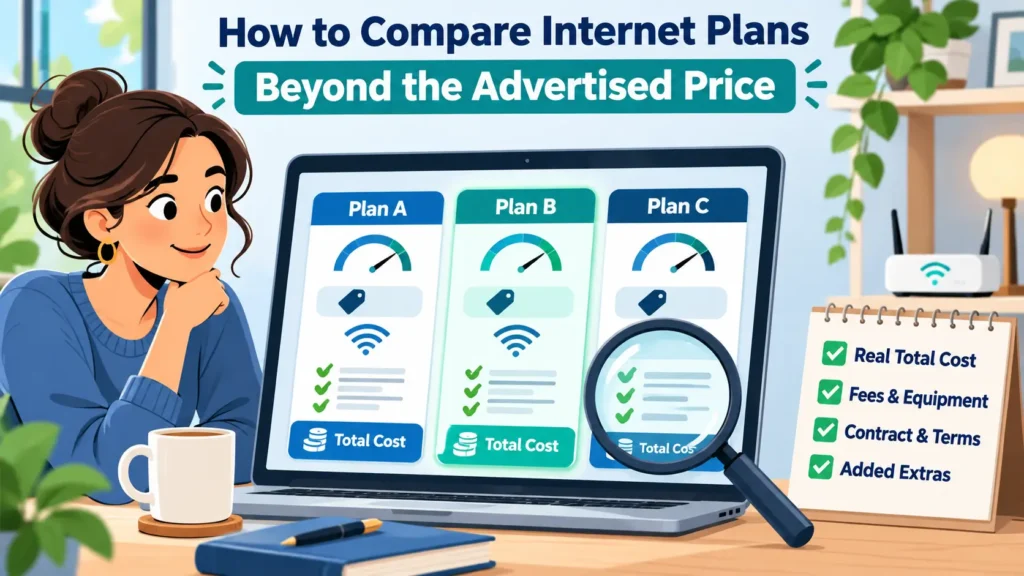
The best internet plan for your household is the one that meets your needs at a price you understand and can afford. Start by checking what’s available at your address, then look beyond the headline speed and monthly rate.
Compare each plan using the same factors:
- The monthly price and how long it lasts
- Any required discounts or bundles
- Equipment, installation, and other fees
- Download and upload speeds
- The type of internet connection
- Data limits and network management policies
- Contract and cancellation terms
- Installation options and equipment
A side-by-side comparison can reveal that a plan with a higher advertised price offers better value, or that a lower-cost plan already provides everything you need.
Start With the Internet Providers Available at Your Address
Before comparing plans, find out which providers serve your specific address. A company may offer service in your city but not on your street, in your building, or at your home.
Enter your address on each provider’s website or contact the provider directly. Ask which technologies and speed tiers are available there. A provider that advertises fiber in your area may offer a different type of connection at your address.
If you live in an apartment or condominium, check whether the building has existing wiring or arrangements that affect your options. Availability can also differ between units in the same building.
You can use the FCC National Broadband Map as a starting point to explore reported availability. Then confirm plans, installation, and pricing with the provider before making a decision.
Our internet service provider guide can also help you explore providers and services.
Look Beyond the Advertised Monthly Price
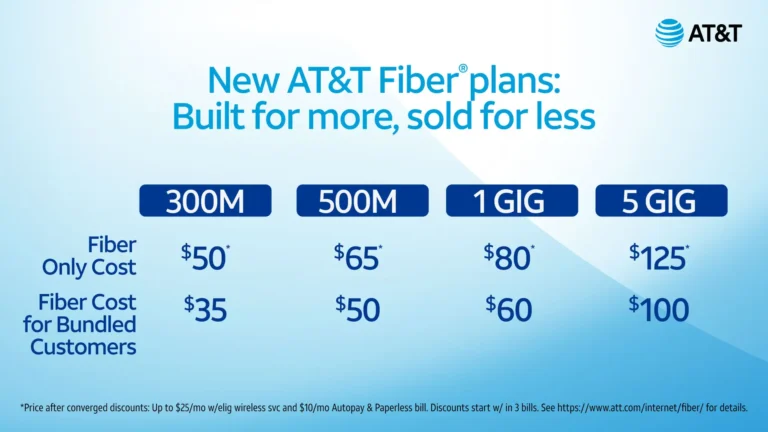
Internet advertisements often lead with an attractive monthly rate. That number can be useful, but it may depend on a promotion or discount.
Before you compare prices, ask:
- How long does the advertised rate last?
- What price applies after the promotion ends?
- Does the price require AutoPay and paperless billing?
- Does it require a qualifying mobile plan or another service?
- Are equipment charges included?
- Are taxes and other fees included?
- Is the rate available to existing customers or only new customers?
For example, a plan advertised at $45 per month may require a $10 AutoPay discount. If you choose not to enroll or don’t meet the payment requirements, your monthly price may be higher.
A provider may also change the regular price after an introductory period. Ask for the expected post-promotion price and keep a copy of the offer details.
Tip: Compare the price you expect to pay under your own circumstances, not just the lowest price shown in an advertisement.
Check AutoPay and Paperless Billing Requirements
Many providers offer discounts when customers enroll in AutoPay, paperless billing, or both. These discounts can lower the monthly bill, but the terms matter.
For instance, a provider may offer a larger discount when you pay from a bank account than when you use a credit card. The discount may also take a billing cycle or more to appear.
Ask what happens if:
- You change your payment method.
- A payment fails.
- You cancel AutoPay.
- You stop receiving paperless statements.
If you prefer not to enroll, add the undiscounted amount to your comparison. That will give you a more realistic estimate of your monthly cost.
Understand Promotional Rates and Price Guarantees
An introductory offer and a price guarantee are not necessarily the same thing.
A promotional rate generally provides a discount for a stated period. When it ends, your monthly charge may increase.
A price guarantee may promise that a specified price will remain in place for a set period. However, the guarantee may apply only to the base internet service, not taxes, equipment, optional services, or other charges.
Before signing up, check:
- When the promotion or guarantee begins.
- How long it lasts.
- Which charges it covers.
- What happens if you change plans or remove a bundled service.
- Whether the provider states a price after the offer ends.
A longer guarantee can make budgeting easier, but it doesn’t automatically make a plan the least expensive option. Compare the full expected cost over the period you plan to keep the service.
Add Equipment Costs to Your Comparison
Most home internet connections need equipment supplied by the provider, purchased by the customer, or both. Depending on the service, this may include a modem, router, gateway, or fiber equipment.
Some plans include equipment in the monthly price. Others charge a separate rental fee or offer optional upgrades, such as additional mesh Wi-Fi devices.
Ask the provider:
- Is the required equipment included?
- Is there a monthly rental charge?
- Are Wi-Fi extenders or mesh units included?
- Can I use my own compatible equipment?
- What happens if the equipment is damaged or not returned?
- Does the equipment support the speed tier I’m considering?
If you plan to purchase your own equipment, confirm compatibility before buying. A cable modem, for example, must work with the provider’s network and the selected service tier.
Also check the support arrangement. A provider may troubleshoot its own equipment but offer limited help with a customer-owned router.
Our modem vs router guide explains what these devices do and how gateways and fiber equipment fit into a home network.
Consider Installation and Other One-Time Fees
The monthly charge isn’t the only expense to check. A new connection may come with one-time costs, including:
- Professional installation
- Self-installation or equipment shipping
- Activation or setup
- Special wiring or nonstandard installation
- Equipment purchases
Some providers waive certain fees during a promotion or when you order online. Others offer a self-installation kit at a lower cost than a technician visit.
However, self-installation may not be available or practical at every address. If your home needs a new line, additional wiring, or specialized equipment, a technician may be necessary.
Ask for an estimate of all one-time charges before placing the order. If the final cost depends on a site visit, find out when the provider will confirm it.
Compare Download and Upload Speeds
Internet plans often advertise download speed most prominently. Download speed affects activities such as streaming video, loading websites, and downloading files.
Upload speed matters when you send information from your home to the internet. Common examples include:
- Uploading photos and videos
- Backing up files to the cloud
- Sending large work files
- Livestreaming
- Using video calls
- Running internet-connected security cameras
Two plans may advertise the same download speed but offer different upload speeds. That difference can matter in a household with several people working, studying, or sharing content at the same time.
Some fiber plans offer symmetrical speeds, meaning their advertised upload and download speeds are the same. Other plans, including many cable and fixed wireless plans, may offer lower upload speeds than download speeds. The exact performance depends on the plan and provider.
Read our upload vs download speed guide to see how each affects everyday activities.
Decide How Much Speed Your Household Needs
A faster plan can be useful, but paying for the highest available speed doesn’t guarantee a better experience for every household.
Think about how many people use the connection at the same time and what they do online. A household that streams video and browses the web may have different needs from one that regularly transfers large files, livestreams, or supports several simultaneous video calls.
Also consider whether a faster plan improves upload speed or only download speed. For some households, a plan with better uploads may be more useful than one with a higher advertised download number.
Keep in mind that a single device may not reach the full speed of a high-speed plan. Your router, Wi-Fi signal, device capabilities, and the website or service you’re using can all affect results.
Our guide to how much internet speed you need explains common speed tiers and the households they may suit.
Compare Connection Types, Not Just Speeds
Internet service can reach your home through several technologies. Two plans with similar advertised speeds may perform differently depending on the connection and local network conditions.
Common options include:
- Fiber: Uses fiber-optic lines to deliver internet service. Many fiber plans offer fast uploads and low latency, although availability varies.
- Cable: Uses a cable network and can offer high download speeds. Upload speeds depend on the provider’s network and plan.
- DSL: Uses telephone lines. Speeds can vary significantly based on the network and the distance to provider equipment.
- Fixed wireless and 5G home internet: Deliver service wirelessly to equipment at your home. Performance can depend on signal quality, location, and network congestion.
- Satellite: Can serve locations with limited wired options. Performance and latency vary by provider and satellite system.
No connection type guarantees the same experience at every address. Compare the actual plans available to you, including their speeds, data policies, equipment, and costs.
For a closer look, read our guide to the types of internet connections.
Don’t Forget Latency and Reliability
Speed is only one part of internet performance. If you play online games, use video calls, or access a remote computer, latency can also affect your experience.
Latency is the time it takes data to travel between your device and another point on the network. Higher latency can make an online game feel less responsive or create noticeable delays during a conversation.
A faster download plan doesn’t automatically solve a latency problem. Your connection type, Wi-Fi signal, network congestion, and distance to the service you’re using can all play a role.
Reliability matters, too. If your household depends on internet access for work or school, ask neighbors about their experiences and check the provider’s installation and support options.
Learn more about internet latency, ping, and lag.
Read the Data Policy
Some internet plans include unlimited data. Others set a monthly data allowance or apply different network management rules after a certain amount of use.
Before choosing a plan, find out:
- Does the plan have a monthly data allowance?
- What happens if you exceed it?
- Are there additional charges?
- Could speeds be reduced after a threshold?
- Could traffic be prioritized differently during congestion?
- Is an unlimited-data option available, and does it cost extra?
These questions can be especially useful if your household streams heavily, downloads large games, backs up files, or uses multiple security cameras.
Unlimited data doesn’t always mean identical performance at all times. Read the plan’s terms to understand any congestion management or priority rules.
Check Contracts and Cancellation Terms
Some providers offer month-to-month service. Others may require a term agreement or offer a lower price when you commit for a specified period.
A contract may work well if you expect to stay at the same address and want the associated offer. However, it can be less convenient if you may move or switch providers soon.
Before ordering, ask:
- Is there a required service term?
- Is there an early termination fee?
- How is that fee calculated?
- What happens if I move to an address the provider doesn’t serve?
- Are there charges for canceling optional equipment or services?
- How and when must I return rented equipment?
A plan advertised as having no annual contract may still have equipment-return obligations or other terms. Review the agreement before assuming there are no costs associated with leaving.
Be Careful With Internet and Mobile Bundles
A provider may offer a discount when you combine home internet with wireless phone service. Bundling can save money, but the internet discount alone doesn’t show whether the whole package is a good deal.
Compare the combined cost of the internet and mobile plans with what you would pay separately. Include device payments, required plan upgrades, taxes, and any features you would otherwise have to purchase.
For example, saving $20 per month on internet may not help if the required wireless plan costs $30 more than the plan that meets your needs.
Also check what happens if you cancel one service. The remaining service may lose its bundle discount.
If you’re reviewing your wireless bill at the same time, our article on how to choose a cell phone plan without overpaying can help.
Compare the Total Cost Over Two Years
A useful way to compare internet plans is to estimate the total cost over the same period. Twenty-four months can be a helpful starting point, especially when one offer has a short introductory price.
Use this calculation:
Total estimated cost = monthly charges during each pricing period + one-time fees + known equipment costs − credits you expect to receive
The following example is hypothetical. It does not represent an offer from a specific provider.
| Cost | Plan A | Plan B |
|---|---|---|
| Monthly internet price, months 1–12 | $40 | $55 |
| Monthly internet price, months 13–24 | $70 | $55 |
| Monthly equipment fee | $10 | Included |
| One-time installation fee | $50 | $0 |
| Estimated cost over 24 months | $1,610 | $1,320 |
Here’s how the totals were calculated:
- Plan A: ($40 × 12) + ($70 × 12) + ($10 × 24) + $50 = $1,610
- Plan B: ($55 × 24) + $0 = $1,320
Plan A starts with a lower advertised internet price, but Plan B costs $290 less over two years in this example.
The calculation assumes the listed prices remain in effect for the periods shown. It excludes taxes, optional services, changes in fees, and other costs that may apply.
Price isn’t the only factor, though. If Plan A offers substantially better upload speeds or a more suitable connection, it may still be worth considering. Use the total cost alongside the performance and features your household needs.
Use the Broadband Consumer Label
When shopping for internet, look for the plan’s broadband consumer label. These labels are designed to help customers compare key details in a consistent format.
A label can help you find information such as:
- The monthly price and introductory terms
- One-time and recurring fees
- Contract information, when applicable
- Typical download and upload speeds
- Typical latency
- Data allowances
- Links to network management and privacy information
The label is a useful starting point, but you should still review the full offer and confirm your final price. Discounts, bundles, availability, and optional services may require additional explanation.
Save a copy of the label and order summary when you sign up. They can help you remember the terms you reviewed.
Compare Providers Side by Side
Once you know which services are available at your address, narrow the list to two or three realistic options. Then compare them using the same criteria.
| What to compare | Questions to ask |
|---|---|
| Monthly price | What will I pay now and after any promotion? |
| Discounts | Do I need AutoPay, paperless billing, or another service? |
| Equipment | Is it included, rented, or purchased separately? |
| One-time costs | Are there installation, activation, or shipping fees? |
| Speeds | What are the advertised download and upload speeds? |
| Connection | Is the service fiber, cable, DSL, fixed wireless, or satellite? |
| Data | Is there an allowance, overage charge, or priority policy? |
| Contract | Is there a term agreement or early termination fee? |
| Installation | Can I install it myself, or is a technician needed? |
| Total cost | What is the estimated cost over 12 or 24 months? |
Ready to compare specific services? Explore our Internet provider comparison to see how featured Fiber and 5G Home Internet options differ in speed, pricing, equipment, data policies, and contract terms.
Ask These Questions Before You Order
Before you agree to a plan, contact the provider or review the online checkout summary. Make sure you can answer the following:
- What is my estimated monthly bill, including required equipment?
- Which discounts are included in that estimate?
- How long will the promotional price last?
- What is the expected price after the promotion?
- What are the one-time installation and activation charges?
- What download and upload speeds does this plan advertise?
- Is there a data allowance or a policy that may affect speeds?
- Is there a contract or early termination fee?
- What equipment must I return if I cancel?
- Can I receive the offer details and agreement in writing?
If an answer is unclear, ask the provider to explain it before you order. Keep the order confirmation, promotional terms, and any written estimates with your account records.
How to Choose the Best Internet Plan for Your Household
After comparing the details, think about which plan fits your priorities.
Choose based on total cost if keeping the monthly bill predictable is most important. Pay attention to the post-promotion rate, required discounts, and equipment charges.
Choose based on performance if several people work or study from home, upload large files, or need a responsive connection. Consider upload speeds and latency along with download speed.
Choose based on flexibility if you may move soon or prefer to switch providers without a long commitment. Review contract terms and equipment-return rules.
Choose based on availability if your area has limited options. A practical plan that serves your address and meets your needs may be a better fit than a faster service that isn’t available.
You don’t need to choose the most expensive plan to get good value. You need a plan that supports what your household does online, with costs and terms you understand.
Frequently Asked Questions About Comparing Internet Plans
What should I compare besides internet speed?
Compare the monthly price, promotional period, upload speed, connection type, equipment costs, data policy, installation charges, and contract terms. Also check availability at your specific address.
Is the cheapest internet plan always the best deal?
No. A low advertised rate may increase after a promotion or require discounts you don’t want to use. Compare the estimated total cost over the same period and make sure the plan meets your household’s needs.
How can I find out what an internet plan will really cost?
Review the broadband consumer label, offer terms, and checkout summary. Add the expected monthly charges, equipment fees, and one-time costs. Ask the provider to confirm the price after any introductory period.
Do I need the fastest internet plan available?
Not necessarily. Many households can use a lower-priced plan comfortably. Consider the number of simultaneous users, the activities they do, and the upload speed they need before paying for a faster tier.
Are equipment fees always charged separately?
No. Some providers include required equipment in the monthly price, while others charge a rental fee or offer optional equipment upgrades. Check the details for the specific plan.
Can I compare internet plans without a contract?
Yes. Some providers offer month-to-month plans. Compare their prices and terms with any term-based offers, and check whether equipment-return requirements or other charges still apply.
Where can I check which internet providers serve my address?
Start with provider websites and confirm availability using your full address. You can also use the FCC National Broadband Map to explore reported availability, then verify the result with the provider.
Should I bundle internet and mobile service?
A bundle may save money if both services meet your needs. Compare the total cost of the bundle against separate plans, and check what happens to the discount if you cancel either service.
The Best Internet Deal Is the One That Fits Your Needs
A good internet deal offers more than an attractive introductory price. It provides the performance, flexibility, and support your household needs at a cost you can understand.
Take time to compare the full monthly bill, expected price changes, equipment, upload speeds, and contract terms. A few minutes spent reviewing those details can help you avoid an unsuitable plan and choose a service with greater confidence.